Maximilian and This Man's Search for Meaning Part One

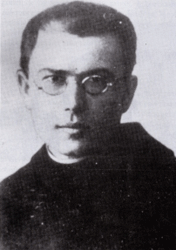 How I came to be in this prison is a story told elsewhere, by me and by others. How I "met" Father Maximilian Kolbe 60 years after he surrendered his life at Auschwitz is a story about actual grace. In his Catholic Catechism, Jesuit Father John Hardon defines actual grace as God's gift of "the special assistance we need to guide the mind and inspire the will" on our path to God. Sometimes, it's very special.My first three years in prison are a blur in my memory. There is no point trying to find words to express the sense of loss, of alienation, of being cast into an abyss that was not of my own making -- a loss that could not be grounded in any reality of mine.About 1,000 days and nights passed in the abyss before what Father Hardon described as "special assistance" crossed my path.Someone, somewhere -- I don't know who -- sent the prison's Catholic chaplain (a layman then) a book entitled Man's Search for Meaning by Viktor Frankl, M.D. Somewhere in my studies, I heard of this book, but only a prisoner can read it in the same light in which it is written. The chaplain called me to his office. He wanted to know whether he should recommend this book, but didn't have time to read it. He wanted my opinion.It had been three years since anyone had asked my opinion on anything. I didn't read Dr. Frankl's book so much as devour it. I read it through three times in seven days. As a priest, I often preached that grace is a process and not an event. It is not always so. I was meant to read Man's Search for Meaning at the precise moment that it landed upon my path. A week earlier, I would not have been ready. A week later may have been too late.I was drowning in the solitary sea of deeply felt loss. I was not going to make it across. My priesthood and my soul were dying. The book, as I have come to call it, is Viktor Frankl's vivid account of how he was alone among his family to survive imprisonment at Auschwitz. This was an imprisonment imposed on him for who he was: a Jew.There is a central message in this small book. A profound message, so clear in meaning, that it has within it the hallmark of inspired truth. Like Saul thrown from his mount, I remember sinking to the floor when I read it.
"There is a freedom that no one can ever take from you: The freedom to choose the person you are going to be in any set of circumstances."
This changed everything. Everything! You will see how later. At the very end of his book, Dr. Frankl revealed the name of his inspiration for surviving Auschwitz. He wrote of Sigmund Freud's cynical view that man is self-serving. And a man's instinctual need to survive will trump "quaint notions" such as grace and sacrifice every time. For Dr. Frankl, Auschwitz provided the proof that Freud was wrong.
That proof is Father Maximilian Kolbe.
To be continued in Maximilian and This Man's Search for Meaning Part TwoPlease share your thoughts below in the comment area.